Part of our digital marketing series. Need hands-on help? See our ChatGPT Ads management service.
Hundreds of millions of people now ask ChatGPT what to buy, which tool to choose and who to hire. Until recently there was no way for a business to pay to be part of those conversations. That has changed. OpenAI now runs ChatGPT Ads, and any eligible business can create campaigns in a self-serve ChatGPT Ads Manager.
This guide explains how ChatGPT advertising works, where the ads appear, how targeting and bidding work, what it costs, which businesses are allowed and how to decide if it is worth testing for your company. ChatGPT Ads is a new product and it changes often, so always check the current rules inside Ads Manager before you launch.
Talk to us about your first ChatGPT Ads campaign →
Key takeaways
- ChatGPT Ads are labeled sponsored units shown with ChatGPT answers. They do not change what ChatGPT says.
- Ads are shown to logged-in users on the Free and Go plans. Plus, Pro, Business, Enterprise and Edu users do not see them.
- There are no keywords. Ads are matched to the conversation using your context hints, landing page and ad text.
- You can bid by cost per click (CPC), cost per thousand impressions (CPM) or for conversions.
- OpenAI suggests starting around $3 to $5 per click. Advertisers report a wide range above that, depending on the niche.
- Tracking uses the OpenAI pixel, the Conversions API and UTM links. Set them up before you spend anything.
In this guide
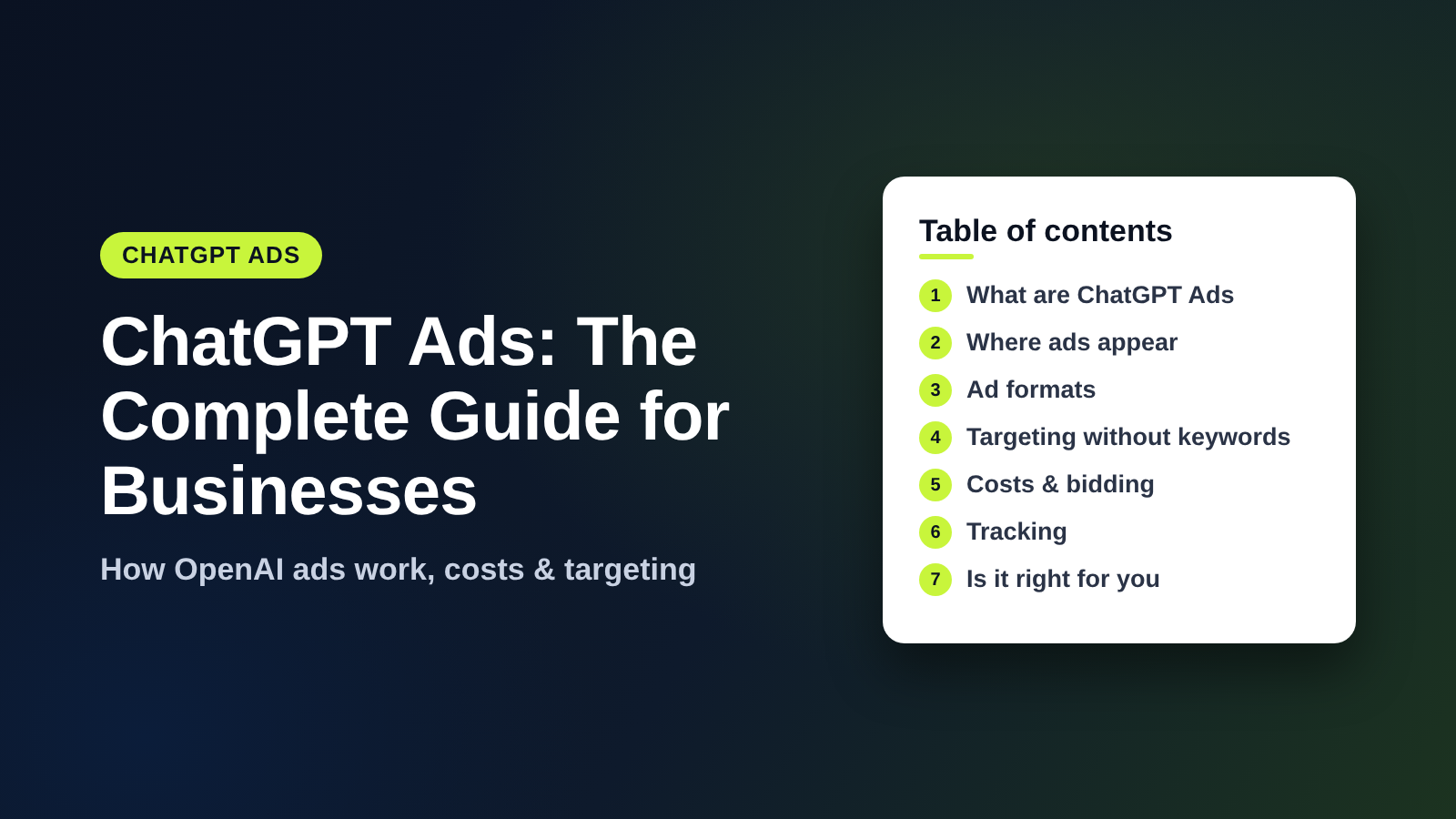
- What are ChatGPT Ads?
- How ChatGPT advertising launched
- Where ads appear and who sees them
- ChatGPT ad formats
- How targeting works without keywords
- How much do ChatGPT Ads cost?
- Tracking and measurement
- Who can advertise: allowed and restricted categories
- Is ChatGPT advertising right for your business?
- ChatGPT Ads vs Google Ads
- How to get started
- Frequently asked questions
What are ChatGPT Ads?
ChatGPT Ads is OpenAI’s advertising platform. It lets businesses show a clearly labeled sponsored message next to relevant ChatGPT conversations. If someone asks ChatGPT for the best project management tool for a small agency, a SaaS company can appear in a sponsored card below the answer. If someone plans a weekend in Lisbon, a hotel or tour company can appear in the same way.
The important difference from search ads is intent depth. On Google, people type three or four words. In ChatGPT they explain their situation in full sentences: their budget, their team size, what they tried before and what they need. That gives the ad system rich context and gives advertisers a chance to reach people at the moment they are making a decision.
OpenAI has been clear on two rules that shape the whole product. First, ads do not influence ChatGPT’s answers. The answer is generated the same way with or without ads. Second, advertisers never see users’ chats. Reporting is aggregated, so you see impressions, clicks and conversions, not what people typed.
How ChatGPT advertising launched
The rollout moved fast:
- Pilot phase: a managed pilot with large brands and high minimum commitments.
- Lower entry barrier: the minimum spend for the pilot dropped sharply.
- Self-serve launch: the self-serve ChatGPT Ads Manager opened to US businesses at ads.openai.com, with CPC bidding.
- New features: conversion bidding, customer-list audiences and expansion to more countries, including the UK, Japan, South Korea, Brazil and Mexico.
- Global expansion: launch across Europe and self-serve access in more regions.
- Today: ads running in more than 60 countries, plus integrations with tools such as Shopify and HubSpot and new measurement partners.
Many businesses received an email titled “ChatGPT Ads are now available to you” when their account became eligible. If you got that email, you can already open Ads Manager and start building.
Where ads appear and who sees them
ChatGPT ads appear with the answer, in a visually separate area marked as sponsored. Up to two ads from different advertisers can show in the same space. They do not appear inside the text of the answer itself.
Who sees ads:
- Logged-in adults on the Free and Go plans.
- Not users on Plus, Pro, Business, Enterprise or Edu plans.
- Not users that OpenAI believes are under 18.
- Not in sensitive conversations, such as health or personal crisis topics.
The Free and Go audience is still huge. It includes students, freelancers, small business owners, shoppers and travelers in every market where ads are live.
ChatGPT ad formats
The main format is a simple ad card. It includes:
- Your advertiser name and favicon
- A short title (OpenAI recommends roughly 16 to 24 characters)
- A short description (roughly 32 to 48 characters)
- A square (1:1) image
- A link to your landing page
Those limits are tight. Writing a clear title and line of copy that still matches the conversation is a real skill, and it is where much of the performance comes from.
OpenAI is also testing richer formats. Product feed ads show product cards with price and rating, a multi-product carousel is in testing, and Sponsored Agents let selected brands open a separate, labeled chat with their own assistant. Expect more formats over time.
How targeting works without keywords
This is the biggest change for anyone coming from Google Ads. You do not bid on keywords. The system reads the conversation and decides which ads are relevant. You influence that decision with four levers:
- Context hints. A free-text field at ad group level where you describe the people and situations you want to reach. For example: “Small agency owners comparing project management tools for a team of 5 to 20 people.”
- Your landing page. The system reads it, so a focused page with clear wording helps it understand your offer.
- Your ad title and copy. They are also used as relevance signals.
- Location and audiences. Target or exclude countries, regions and in the US even postal codes. Upload customer lists (hashed emails or phone numbers) to include, exclude or bid up on known customers. Lists need at least 25,000 matched users.
Because the system is a relevance-weighted auction, a highly relevant ad with a lower bid can beat a weak ad with a higher bid. Good context hints and creative are not a nice extra. They decide whether you win impressions at a fair price.
How much do ChatGPT Ads cost?
There are two costs: what you pay OpenAI for media, and what you pay for setup and management if you hire help.
Bidding options
- CPC: you pay per click. OpenAI recommends a starting bid of about $3 to $5. Advertisers have reported real CPCs from about $3 up to more than $20 in competitive niches.
- CPM: you pay per thousand impressions. Reported CPMs range from about $25 to above $60.
- Conversion bidding: the system optimizes for conversions you track. It needs a working pixel or Conversions API first.
New ad groups default to automatic “Maximize results” bidding. You can switch to manual bids if you want a hard ceiling.
Budgets and billing
There is no large published minimum for self-serve accounts, so a small business can test with a modest daily budget. Billing is postpay: you save a card and it is charged each time your unpaid spend reaches a threshold. A failed payment can pause your ads, so keep your card up to date.
A sensible first test is a small daily budget for two to four weeks, enough clicks to see which context hints and ads perform, then scale the winners.
Tracking and measurement
Retroactive tracking is not possible, so measurement must be ready before launch. ChatGPT Ads Manager supports:
- The OpenAI pixel on your website for page views, sign-ups, leads and purchases.
- The Conversions API for server-side events, which is more reliable when browsers block scripts.
- UTM parameters on ad links, so you can see ChatGPT traffic in Google Analytics and your CRM.
- Integrations with platforms such as Shopify and HubSpot, plus adjustable attribution windows.
Reports show impressions, clicks, CTR, spend, average CPC and CPM, conversions, sales value and ROAS, and you can export them as CSV. Agencies have noticed differences between platform numbers and their own analytics, so compare both and use UTMs as your neutral check.
Who can advertise: allowed and restricted categories
To open an account you need an OpenAI login, business details (name, website, address and registration information), a favicon and a payment method. Agencies should not create accounts for clients. The client creates the account and invites the agency as a team member, which also keeps ownership with the business.
Generally allowed: ecommerce and household goods, software and SaaS, travel and experiences, digital products, education and many local and professional services.
Limited, with extra rules: financial services, healthcare, legal services and some travel-related casino content.
Not allowed: adult content, tobacco, alcohol above low strength, drugs, gambling, political ads, cryptocurrency, credit repair, debt services and counterfeit goods, among others.
The lists are still evolving and sometimes conflict, so check your category in Ads Manager before planning a big campaign.
Is ChatGPT advertising right for your business?
ChatGPT Ads work best when people research before they buy and are likely to ask an assistant for advice. Strong early fits include:
- B2B and SaaS: “best CRM for a small sales team” is a typical ChatGPT question.
- Online courses and coaching: people ask how to learn a skill and which course to take.
- Ecommerce with considered purchases: furniture, electronics, beauty, fashion and gifts.
- Travel and experiences: itineraries, tours and hotels.
- Agencies and professional services: “how do I find a good web designer” is a buying moment.
It is a weaker fit if your product is very cheap and bought on impulse, if your category is restricted or if you have no way to track conversions yet.
ChatGPT Ads vs Google Ads
- Targeting: Google uses keywords. ChatGPT uses conversation context, hints and audiences.
- Intent: Google captures short queries. ChatGPT captures long, detailed questions that often come right before a decision.
- Competition: Google is mature and crowded. ChatGPT Ads is new, so early advertisers can learn the platform before costs rise.
- Data: Google has years of benchmarks. ChatGPT Ads has few public benchmarks, so careful testing matters more.
For most businesses the answer is not “either or”. Keep your proven Google Ads and SEO work running, and use a controlled test budget to find out what ChatGPT advertising can add.
How to get started
- Sign in at ads.openai.com and complete business verification.
- Add your advertiser name, favicon and payment card.
- Install the pixel or Conversions API and add UTMs.
- Build one campaign with two or three ad groups, each with clear context hints.
- Write three ads per group and use square images.
- Submit for review, launch with a small budget and review results weekly.
Our step-by-step ChatGPT Ads Manager setup guide walks through each screen in detail.
If you would rather have experts do it, MIVAQ sets up and manages ChatGPT Ads campaigns end to end: account setup, tracking, context hints, ad creative, bidding and reporting. You keep full ownership of your account. Learn more about our ChatGPT Ads service or send us your website and we will tell you honestly if your business is a good fit.
Frequently asked questions
Do ChatGPT Ads change ChatGPT’s answers?
No. OpenAI states that ads do not influence answers. Ads are shown separately and marked as sponsored.
Can advertisers see what users type?
No. Advertisers only see aggregated reports such as impressions, clicks and conversions.
Who sees ChatGPT ads?
Adult users on the Free and Go plans in countries where ads are live. Paid plans such as Plus and Pro are ad-free.
What is the minimum budget for ChatGPT Ads?
Self-serve accounts have no large published minimum. Most businesses start with a small daily budget and scale what works.
Can I run ChatGPT Ads outside the US?
Yes. Ads are now live in more than 60 countries, including the UK and Europe. Check your country in Ads Manager.
Do I need an agency?
No, but the platform is new and tracking mistakes are expensive. A specialist can set things up correctly the first time and save test budget.